

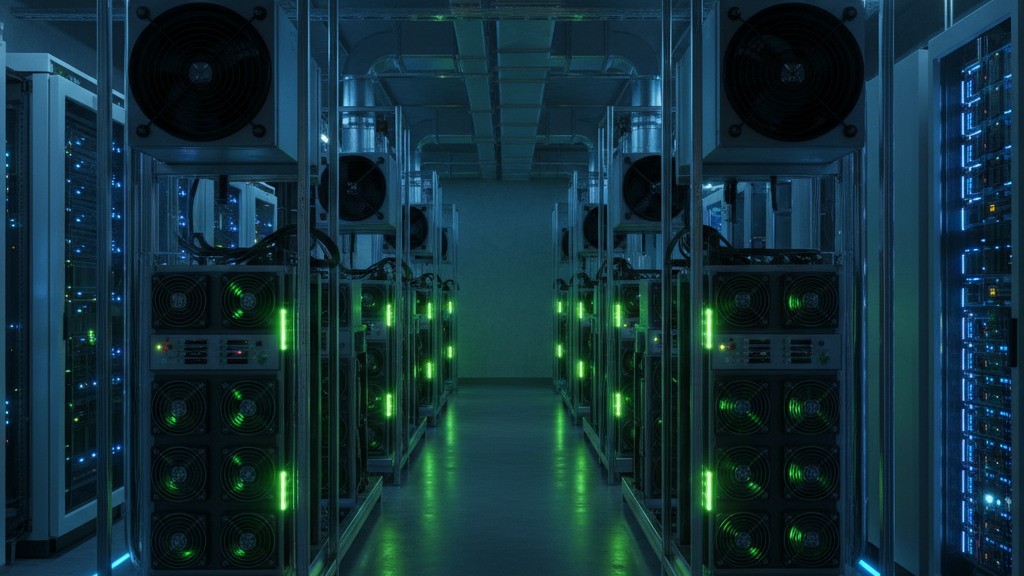
Cryptocurrency mining is the process of using specialized computer hardware to validate transactions on a blockchain network and earn newly created coins as a reward. Miners compete to solve complex mathematical puzzles, and the first to find a valid solution gets to add the next block of transactions to the chain. This mechanism secures decentralized networks like Bitcoin without requiring a central authority.
Mining remains one of the most fundamental aspects of cryptocurrency, underpinning the security and operation of major networks worth hundreds of billions of dollars. Whether you are curious about how it works or considering becoming a miner yourself, understanding this process is essential for anyone involved in the crypto space.
How Does Cryptocurrency Mining Work?
Cryptocurrency mining works by having computers compete to solve cryptographic puzzles that validate groups of transactions. When a miner successfully solves the puzzle, they broadcast their solution to the network, earn a block reward in cryptocurrency, and the validated transactions become permanently recorded on the blockchain. This process repeats approximately every ten minutes for Bitcoin.
The mining process involves several interconnected steps that maintain network security and create new coins:
Transaction Collection: When users send cryptocurrency, their transactions enter a waiting area called the mempool. Miners select transactions from this pool, typically prioritizing those with higher fees, and bundle them into a candidate block.
Block Construction: The miner assembles a block header containing essential information: a reference to the previous block (creating the chain), a summary of all included transactions (Merkle root), a timestamp, the current difficulty target, and a variable number called the nonce.
Hash Computation: Mining hardware repeatedly calculates cryptographic hashes of the block header while changing the nonce value. A hash is a fixed-length string of characters produced by running data through a one-way mathematical function. Even tiny changes to input data produce completely different hash outputs.
Difficulty Target: The network sets a difficulty level requiring the hash to start with a certain number of zeros. With Bitcoin, this target adjusts every 2,016 blocks (roughly two weeks) to maintain the ten-minute block time regardless of how much computing power joins or leaves the network.
Block Propagation: When a miner finds a valid hash, they immediately broadcast the solution to other nodes. These nodes verify the hash meets requirements and that all transactions are legitimate before accepting the block and adding it to their copy of the blockchain.
Reward Distribution: The successful miner receives the block reward (currently 3.125 BTC for Bitcoin after the April 2024 halving) plus all transaction fees from included transactions. This reward is automatically sent to the miner's wallet address specified in the block.
What is Proof of Work?
Proof of Work (PoW) is a consensus mechanism that requires miners to expend computational energy solving puzzles before they can add blocks to the blockchain. This energy expenditure makes attacking the network prohibitively expensive because an attacker would need to control more than half of all mining power to manipulate transactions. PoW was introduced by Bitcoin in 2009 and remains the security foundation for the largest cryptocurrencies by market cap.
The genius of Proof of Work lies in its elegant solution to the double-spending problem without requiring trusted intermediaries. Before Bitcoin, digital currencies faced an insurmountable challenge: how do you prevent someone from copying digital money and spending it twice? Traditional systems solved this with central authorities like banks that maintain definitive records.
Satoshi Nakamoto's innovation was requiring miners to prove they expended real-world resources (electricity and hardware) before earning the right to write transactions. This creates several critical properties:
Sybil Resistance: Anyone can join the network, but influence is proportional to computational work performed rather than the number of accounts created. This prevents attackers from overwhelming the network with fake identities.
Immutability: Changing historical transactions requires redoing all the work from that point forward while outpacing honest miners. As blocks stack on top of each other, reversing old transactions becomes exponentially more difficult.
Decentralized Consensus: Nodes independently verify that blocks meet difficulty requirements without needing to trust other participants. The longest valid chain with the most accumulated work becomes the canonical truth.
Fair Distribution: New coins are distributed to those who contribute security to the network rather than through arbitrary allocation decisions by central parties.
Proof of Work vs Proof of Stake Comparison
| Feature | Proof of Work | Proof of Stake |
|---|---|---|
| Security Mechanism | Computational power expenditure | Economic collateral at risk |
| Hardware Requirements | Specialized mining equipment | Standard computer sufficient |
| Energy Consumption | High (comparable to small countries) | Minimal (99%+ less than PoW) |
| Entry Barrier | Equipment cost and electricity access | Minimum stake requirement |
| Attack Cost | 51% of network hashrate | 51% of staked tokens |
| Block Production | Competitive race among miners | Validator selection algorithm |
| Network Examples | Bitcoin, Litecoin, Dogecoin | Ethereum, Cardano, Solana |
| Decentralization Risk | Mining pool concentration | Wealth concentration |
| Proven Security | 15+ years without successful attack | Newer, less battle-tested |
| Revenue Model | Block rewards + fees | Staking rewards + fees |
For a detailed comparison of these approaches, see our guide on staking vs mining.
Types of Mining Hardware
Mining hardware has evolved dramatically from ordinary computers to highly specialized machines designed for maximum efficiency. The right equipment depends on which cryptocurrency you want to mine, your budget, electricity costs, and technical expertise. Modern mining profitability often comes down to hardware efficiency measured in hashes per watt consumed.
Application-Specific Integrated Circuits (ASICs)
ASICs are custom-built chips designed exclusively for mining specific cryptocurrencies. Because they do only one thing, they perform that function far more efficiently than general-purpose hardware. A modern Bitcoin ASIC can compute trillions of hashes per second while consuming a fraction of the electricity that equivalent GPU power would require.
ASIC Advantages:
- Highest hashrate per unit for supported algorithms
- Best energy efficiency (hashes per watt)
- Purpose-built cooling and power systems
- Plug-and-play operation for beginners
ASIC Disadvantages:
- Cannot mine other algorithms if profitability shifts
- Expensive upfront cost (typically $2,000-$15,000)
- Rapid obsolescence as newer models release
- Centralized manufacturing by few companies
- Loud operation (65-80 decibels)
Graphics Processing Units (GPUs)
GPUs were designed for rendering graphics but their parallel processing architecture happens to excel at certain mining algorithms. Unlike ASICs, GPUs can mine many different cryptocurrencies and retain resale value for gaming or professional applications if mining becomes unprofitable.
GPU Advantages:
- Flexibility to mine multiple cryptocurrencies
- Resale value outside of mining
- Widely available from multiple manufacturers
- Quieter home operation possible
- Useful for other computational tasks
GPU Disadvantages:
- Lower efficiency than ASICs for Bitcoin
- Higher electricity cost per hash
- Requires more technical setup knowledge
- Needs proper cooling and power management
- Less profitable for SHA-256 mining
Mining Hardware Comparison Table
| Hardware Type | Best For | Hashrate Range | Power Draw | Typical Cost | Noise Level |
|---|---|---|---|---|---|
| ASIC (Bitcoin) | BTC, BCH | 100-250+ TH/s | 2,500-3,500W | $3,000-$12,000 | 70-80 dB |
| ASIC (Litecoin) | LTC, DOGE | 5-10 GH/s | 2,000-3,000W | $2,000-$8,000 | 65-75 dB |
| High-End GPU | Altcoins | 50-120 MH/s | 200-350W | $500-$1,500 | 40-55 dB |
| Mid-Range GPU | Altcoins | 25-50 MH/s | 120-200W | $250-$600 | 35-50 dB |
| CPU | Limited coins | 1-20 KH/s | 65-150W | $100-$500 | 20-40 dB |
Popular ASIC Models in 2026
Bitmain Antminer S21 Pro: The current flagship Bitcoin miner delivers around 234 TH/s at 3,531 watts, achieving an efficiency of approximately 15 J/TH. Priced between $7,000 and $10,000 depending on availability.
MicroBT Whatsminer M60S: Competing directly with Bitmain, this unit produces 186 TH/s at 3,344 watts with hydro cooling options available for improved performance.
Bitmain Antminer L9: For Litecoin and Dogecoin mining using the Scrypt algorithm, delivering 16 GH/s at approximately 3,360 watts.
Solo Mining vs Pool Mining
Solo mining means running your own mining operation independently, keeping all rewards when you find a block but potentially waiting months or years between successful blocks. Pool mining combines hashpower with other miners to find blocks more frequently, sharing rewards proportionally but providing more consistent income. Most miners today choose pools because the variance in solo mining makes financial planning nearly impossible.
Understanding Mining Pools
A mining pool is a collective of miners who combine their computational resources and share block rewards based on contributed work. When any pool member finds a valid block, the reward distributes to all participants according to their share of the pool's total hashrate.
Pool mining transformed cryptocurrency mining from a lottery into a steady income stream. While solo miners might earn nothing for months then suddenly receive a full block reward, pool miners receive small, regular payments that are much easier to budget around.
For step-by-step instructions on joining a pool, read our comprehensive guide on how to join a crypto mining pool.
Pool Reward Structures
Pay Per Share (PPS): Miners receive a guaranteed payment for each valid share submitted, regardless of whether the pool finds a block. The pool absorbs variance risk, typically charging higher fees to compensate.
Pay Per Last N Shares (PPLNS): Rewards distribute based on shares submitted during the last N shares before a block is found. This method rewards loyal miners who stay with the pool rather than hopping between pools.
Full Pay Per Share (FPPS): Similar to PPS but also includes estimated transaction fee revenue in share payments, providing more complete reward distribution.
Proportional: Simple division of block rewards based on the percentage of total shares each miner contributed during that round.
Solo vs Pool Mining Comparison
| Factor | Solo Mining | Pool Mining |
|---|---|---|
| Reward Frequency | Highly irregular (months to years) | Regular (hourly to daily) |
| Reward Size | Full block reward when successful | Small proportional shares |
| Income Predictability | Nearly impossible to forecast | Relatively steady and plannable |
| Fees | None | 1-3% of rewards typically |
| Luck Dependency | Entirely luck-based short term | Smoothed by pool size |
| Minimum Hashrate | Impractical below petahashes for BTC | Any hashrate viable |
| Technical Complexity | Must run full node | Pool handles infrastructure |
| Privacy | Maximum privacy | Pool knows your hashrate |
| Payout Control | Immediate, no threshold | Pool sets minimum payouts |
Major Mining Pools Comparison
| Pool Name | Market Share (Est.) | Fee Structure | Payout Methods | Minimum Payout |
|---|---|---|---|---|
| Foundry USA | ~30% | 0% (institutional) | FPPS | Varies |
| AntPool | ~18% | 0-4% | PPS+, PPLNS | 0.001 BTC |
| F2Pool | ~12% | 2.5% | PPS+ | 0.001 BTC |
| ViaBTC | ~10% | 2-4% | PPS+, PPLNS | 0.001 BTC |
| Binance Pool | ~8% | 2.5% | FPPS | 0.001 BTC |
Is Crypto Mining Profitable in 2026?
Mining profitability depends on the interplay between your costs (hardware, electricity, cooling, maintenance) and revenues (block rewards, transaction fees, coin price). At current Bitcoin prices and network difficulty, large-scale operations with access to cheap electricity can generate returns, but home miners face significantly tighter margins that often make mining unprofitable without advantageous conditions.
Key Profitability Factors
Electricity Cost: The single most important variable for mining profitability. Commercial operations seek locations with rates below $0.05 per kWh, while home miners often pay $0.10-$0.30 per kWh. This difference alone can determine whether mining is profitable or operates at a loss.
Hardware Efficiency: Newer ASIC generations produce dramatically more hashes per watt than older models. The efficiency gain between generations can mean the difference between profit and loss even with identical electricity rates.
Network Difficulty: As more miners join the network, difficulty increases, reducing the probability of any individual miner finding a block. Difficulty has increased substantially over the past several years as institutional miners deployed massive facilities.
Cryptocurrency Price: Higher prices make mining more profitable in fiat terms, but often attract more miners which increases difficulty. Price volatility adds significant uncertainty to mining investment returns.
Block Reward Schedule: Bitcoin halves its block reward approximately every four years. The April 2024 halving reduced rewards from 6.25 to 3.125 BTC, cutting miner revenue in half overnight unless price compensates.
Profitability Calculation Example
| Factor | Value |
|---|---|
| Mining Hardware | Antminer S21 Pro (234 TH/s) |
| Hardware Cost | $8,000 |
| Power Consumption | 3,531 watts |
| Electricity Rate | $0.08/kWh |
| Daily Electricity Cost | $6.78 |
| Monthly Electricity Cost | $203.40 |
| Estimated Daily BTC Mined | ~0.00045 BTC |
| Monthly BTC Mined | ~0.0135 BTC |
| BTC Price (assumed) | $95,000 |
| Monthly Revenue | ~$1,282.50 |
| Monthly Profit | ~$1,079.10 |
| Hardware Payback | ~7.4 months |
Note: These calculations are estimates based on current network conditions and will vary significantly based on difficulty changes, price movements, and actual hardware performance.
Mining Cost Breakdown
| Cost Category | Percentage of Total | Notes |
|---|---|---|
| Electricity | 60-80% | Dominant cost, location-dependent |
| Hardware Depreciation | 10-25% | ASICs obsolete in 2-3 years |
| Cooling/Infrastructure | 5-10% | Climate and scale dependent |
| Maintenance | 2-5% | Repairs, replacements |
| Pool Fees | 1-3% | Only if pool mining |
| Internet | Less than 1% | Minimal bandwidth needed |
Environmental Impact of Crypto Mining
Bitcoin mining consumes approximately 120-150 terawatt-hours of electricity annually, comparable to the energy usage of countries like Argentina or Norway. This substantial energy demand has generated significant environmental criticism, though the picture is more nuanced than headlines suggest, with miners increasingly utilizing renewable and stranded energy sources.
Energy Consumption Context
The energy debate around mining often lacks context about what that energy accomplishes and how it compares to alternatives. Mining secures a network holding over a trillion dollars in value and processes millions of transactions without intermediaries.
Current Estimates:
- Bitcoin network: 120-150 TWh annually
- Global banking system: ~260 TWh annually
- Gold mining industry: ~130 TWh annually
- Global data centers: ~200-250 TWh annually
Renewable Energy Adoption
Many mining operations actively seek renewable energy sources because they are often the cheapest available electricity:
Hydroelectric Power: Regions like Quebec, Norway, and Sichuan (historically) offered miners access to abundant, cheap hydroelectric power. These operations produce minimal carbon emissions.
Solar and Wind: Miners increasingly co-locate with solar and wind farms, using excess generation that would otherwise be curtailed. Some operations provide demand flexibility that helps grid stability.
Stranded Gas: Oil fields often produce natural gas as a byproduct that cannot economically reach pipelines. Rather than flaring this gas (releasing unburned methane and CO2), some miners use it for power generation, actually reducing emissions compared to the alternative.
Geothermal: Iceland has attracted miners with its abundant geothermal energy and natural cooling climate.
For a deeper analysis of mining's environmental footprint, read our detailed examination: Is Bitcoin Mining Bad for the Environment?
Sustainability Initiatives
The Bitcoin Mining Council reports that its members (representing over 50% of global hashrate) use approximately 60% sustainable energy. While self-reported data has limitations, the trend toward renewable energy is clear as miners pursue the cheapest power sources available.
Getting Started with Crypto Mining
Starting a mining operation requires careful planning around hardware selection, infrastructure setup, and financial projections. For most beginners, joining a mining pool and starting with modest equipment allows learning the process before committing significant capital. Our complete walkthrough on how to mine cryptocurrencies provides detailed step-by-step instructions.
Step 1: Choose What to Mine
Consider these factors when selecting a cryptocurrency:
Algorithm Compatibility: Your hardware determines which algorithms you can efficiently mine. ASICs are locked to specific algorithms, while GPUs offer more flexibility.
Profitability Analysis: Use mining calculators to estimate returns based on current difficulty, rewards, and your electricity costs. Remember these are estimates that change constantly.
Long-term Outlook: Consider the cryptocurrency's fundamentals, development activity, and market position. Mining a coin that loses value defeats the purpose of the operation.
Network Accessibility: Some networks have such high difficulty that meaningful participation requires substantial investment. Others remain accessible to smaller operations.
Step 2: Acquire Mining Hardware
For Bitcoin and Litecoin, ASIC miners are essentially required to be competitive. For other cryptocurrencies, GPU mining may still be viable.
New Hardware: Purchase from authorized retailers or directly from manufacturers. Avoid deals that seem too good to be true, as scams are common in the mining hardware market.
Used Hardware: Can offer significant savings but carries risks of unknown usage history, reduced lifespan, and no warranty. Verify operational status before purchasing.
Hosting Services: Some companies will house, power, and maintain your hardware for a fee. This eliminates infrastructure concerns but adds counterparty risk and reduces margins.
Step 3: Set Up Infrastructure
Mining equipment has significant power and cooling requirements:
Electrical Capacity: A single Bitcoin ASIC requires a dedicated 240V circuit. Multiple units need substantial electrical infrastructure beyond typical residential service.
Cooling Systems: Mining hardware generates significant heat. Proper ventilation or active cooling prevents thermal throttling and extends equipment life.
Internet Connectivity: Mining requires minimal bandwidth but consistent uptime. A backup connection prevents lost mining time during outages.
Noise Management: ASIC miners produce 70-80 decibels, comparable to a vacuum cleaner running continuously. This makes home operation challenging without soundproofing.
Step 4: Configure Mining Software
Connect your hardware to the network:
Pool Selection: Choose a reputable pool based on fees, payout methods, server locations, and historical uptime. Our mining pool guide helps you evaluate options.
Wallet Setup: Create a secure wallet to receive mining rewards. Hardware wallets offer the best security for significant holdings.
Software Installation: ASICs typically come with pre-installed firmware. GPU miners need to install mining software compatible with their chosen cryptocurrency and pool.
Configuration: Enter pool server addresses, your wallet address, and worker identification. Monitor initial operation to ensure everything functions correctly.
Step 5: Monitor and Optimize
Ongoing management improves returns:
Performance Tracking: Monitor hashrate, accepted shares, rejected shares, and hardware temperatures. Significant deviations indicate problems requiring attention.
Firmware Updates: Manufacturers release updates improving efficiency or fixing bugs. Keep firmware current while being cautious about beta releases.
Overclocking/Underclocking: Advanced users can adjust hardware settings to optimize the hash-to-power ratio for their specific electricity costs.
Pool Evaluation: Periodically compare your actual returns against expectations and other pool options. Pool performance can vary over time.
The Future of Cryptocurrency Mining
Mining continues evolving as the industry matures, technology advances, and regulatory frameworks develop. Understanding these trends helps miners and investors make informed decisions about long-term positioning in the space.
Technology Trends
Efficiency Improvements: Each ASIC generation improves the joules-per-terahash ratio, allowing more profitable operation at higher difficulties. This trend will continue until approaching physical limits.
Immersion Cooling: Submerging mining hardware in dielectric fluid dramatically improves cooling efficiency, allowing higher performance and longer equipment life. Adoption is growing among large operations.
Renewable Integration: Purpose-built mining facilities designed around renewable energy sources will likely dominate as miners seek the lowest possible electricity costs.
Market Evolution
Institutional Dominance: Public mining companies and large private operations control an increasing share of hashrate. Economies of scale in power contracts and hardware purchasing create advantages difficult for small miners to match.
Geographic Shifts: Mining activity follows cheap electricity. Recent years saw migration from China to North America, Kazakhstan, and other regions. Future shifts will depend on energy policy and regulation.
Halving Impacts: Bitcoin's next halving (expected 2028) will further reduce block rewards, intensifying pressure on mining margins. Only the most efficient operations will remain profitable unless prices rise substantially.
Regulatory Considerations
Energy Policies: Some jurisdictions have implemented or considered restrictions on mining due to energy concerns. Others actively court miners with favorable policies.
Tax Treatment: Mining rewards are generally taxable income at fair market value when received. Regulatory clarity varies by jurisdiction.
Securities Regulations: While Bitcoin mining itself is well-established, newer mining schemes and mining-related investment products may face securities regulations.
Frequently Asked Questions
What is cryptocurrency mining in simple terms?
Cryptocurrency mining is using computer hardware to validate transactions on a blockchain network and earn rewards. Miners compete to solve mathematical puzzles, and winners receive newly created cryptocurrency plus transaction fees. This process secures the network and creates new coins.
How long does it take to mine one Bitcoin?
The Bitcoin network produces one block approximately every ten minutes, with the current reward being 3.125 BTC. However, individual miners or pools receive rewards based on their share of total network hashrate. A miner with 0.001% of network hashrate would earn about 0.001% of daily rewards, regardless of how long specific blocks take.
Is Bitcoin mining profitable in 2026?
Profitability depends on your specific circumstances. Large operations with access to electricity under $0.05 per kWh and modern equipment can generate positive returns. Home miners paying residential electricity rates often struggle to profit. Calculate your specific situation using current mining calculators and conservative price assumptions.
How much electricity does Bitcoin mining use?
The Bitcoin network consumes approximately 120-150 terawatt-hours annually, comparable to a small country. Individual ASIC miners use 2,500-3,500 watts continuously, translating to $150-$800 monthly in electricity costs depending on local rates.
Can I mine Bitcoin on my regular computer?
Technically yes, but practically no. A standard computer would take hundreds of thousands of years to mine a single Bitcoin block due to competition from specialized hardware. Mining Bitcoin profitably requires ASIC miners specifically designed for the SHA-256 algorithm.
What is the difference between mining and staking?
Mining uses computational power to secure Proof of Work networks, requiring specialized hardware and significant electricity. Staking locks up cryptocurrency as collateral to validate transactions on Proof of Stake networks, requiring minimal hardware but substantial token holdings. Both methods earn rewards for participants.
How do mining pools work?
Mining pools combine hashpower from multiple miners to find blocks more frequently than any individual could alone. When the pool finds a block, rewards distribute to members based on their contributed work. This provides more consistent income compared to solo mining's highly variable returns.
What happens when all 21 million Bitcoin are mined?
The last Bitcoin will be mined around the year 2140. After that, miners will earn only transaction fees rather than block rewards. The expectation is that a robust fee market will develop to continue incentivizing miners to secure the network. This transition will occur gradually as block rewards halve approximately every four years.
Is crypto mining legal?
Cryptocurrency mining is legal in most countries including the United States, Canada, most of Europe, and many others. However, some jurisdictions have banned or restricted mining, and regulations continue evolving. Check your local laws before starting a mining operation.
How do I start mining cryptocurrency as a beginner?
Begin by researching which cryptocurrency you want to mine and what hardware it requires. For most beginners, joining a mining pool and starting with modest equipment makes sense. Our guide to mining cryptocurrencies provides detailed step-by-step instructions for getting started.
What is mining difficulty and how does it affect profits?
Mining difficulty is a network parameter that adjusts how hard the mathematical puzzles are to solve. Higher difficulty means your hardware earns less cryptocurrency. Bitcoin adjusts difficulty every two weeks to maintain ten-minute block times regardless of total network hashrate. Rising difficulty reduces individual profits unless price rises to compensate.
Can cryptocurrency mining damage my computer?
Mining puts continuous heavy load on hardware, potentially shortening component lifespan through heat stress and constant operation. Using dedicated mining equipment rather than personal computers is advisable. Proper cooling, quality power supplies, and monitoring temperatures help prevent damage.
What are the ongoing costs of mining?
Primary ongoing costs include electricity (typically 60-80% of expenses), cooling, internet service, and occasional maintenance or repairs. Pool fees (1-3%) apply if you join a pool. Hardware depreciation is also a significant cost as equipment becomes obsolete within 2-3 years.
Is cloud mining legitimate?
Cloud mining services rent hashpower so users can mine without owning hardware. While some legitimate services exist, the industry has a significant history of scams. Many cloud mining contracts are unprofitable by design. Approach with extreme caution and thorough research, understanding that you could lose your entire investment.
How does Bitcoin halving affect miners?
Bitcoin halving cuts block rewards in half approximately every four years. This immediately reduces miner revenue unless Bitcoin's price rises proportionally. Less efficient miners may become unprofitable and shut down after halvings, eventually reducing network difficulty and improving conditions for remaining miners.


