Bitcompare

Zaufany dostawca stawek i informacji finansowych

TwitterFacebookLinkedInYouTubeInstagram

Najnowsze

  • Ceny kryptowalut
  • Konwertuj
  • Nagrody za Staking Kryptowalut
  • Stawki pożyczek kryptowalutowych
  • Stawki pożyczek kryptowalutowych
  • Stawki pożyczek w stablecoinach
  • Nagrody za Staking Stablecoinów

Najlepszy

  • Platformy Stakingowe w Polsce
  • Konta oszczędnościowe w kryptowalutach
  • Platformy Pożyczkowe w Kryptowalutach
  • Giełdy kryptowalut w Polsce
  • Karty debetowe kryptowalutowe

Ucz się

  • Staking w Polsce
  • Kredytowanie Kryptowalut
  • Kredyty kryptowalutowe

Firma

  • Zostań partnerem
  • Kariera
  • Skontaktuj się z nami
  • O nas
  • Bajty
  • API dla deweloperów
  • Firma Blu.Ventures
  • Status

Zdobądź wiedzę o kryptowalutach w 5 minut

Dołącz do czytelników z Coinbase, a16z, Binance, Uniswap, Sequoia i innych, aby uzyskać najnowsze informacje o nagrodach za staking, porady, spostrzeżenia i wiadomości.

Brak spamu, możesz zrezygnować w dowolnym momencie. Przeczytaj naszą Politykę Prywatności.

PolitykaWarunki użytkowaniaMapa strony

© 2026 Bitcompare

Bitcompare.net to nazwa handlowa Blue Venture Studios Pte Ltd, 68 Circular Road, #02-01, 049422, Singapur

Informacja o reklamie: Bitcompare to silnik porównawczy, który opiera swoje finansowanie na reklamach. Możliwości biznesowe dostępne na tej stronie są oferowane przez firmy, z którymi Bitcompare nawiązał współpracę. Ta relacja może wpływać na sposób i miejsce, w którym produkty pojawiają się na stronie, na przykład w jakiej kolejności są wymieniane w kategoriach. Informacje o produktach mogą być również umieszczane na podstawie innych czynników, takich jak algorytmy rankingowe na naszej stronie internetowej. Bitcompare nie analizuje ani nie wymienia wszystkich firm czy produktów dostępnych na rynku.

Informacja redakcyjna: Treści redakcyjne na Bitcompare nie są dostarczane przez żadną z wymienionych firm i nie zostały sprawdzone, zatwierdzone ani w żaden sposób poparte przez te podmioty. Wyrażone tutaj opinie są wyłącznie autorstwa autora. Dodatkowo, opinie wyrażane przez komentujących niekoniecznie odzwierciedlają poglądy Bitcompare ani jego pracowników. Gdy zostawisz komentarz na tej stronie, nie będzie on widoczny, dopóki administrator Bitcompare go nie zatwierdzi.

Ostrzeżenie: Ceny aktywów cyfrowych mogą być zmienne. Wartość Twojej inwestycji może wzrosnąć lub spaść, a Ty możesz nie odzyskać zainwestowanej kwoty. Tylko Ty jesteś odpowiedzialny za pieniądze, które inwestujesz, a Bitcompare nie ponosi odpowiedzialności za jakiekolwiek straty, które możesz ponieść. Każda podana stopa procentowa (APR) jest przybliżonym oszacowaniem tego, ile kryptowaluty zarobisz w postaci nagród w wybranym przez siebie okresie. Nie pokazuje rzeczywistych ani przewidywanych zwrotów czy zysków w żadnej walucie fiducjarnej. APR jest dostosowywana codziennie, a szacowane nagrody mogą różnić się od rzeczywistych nagród uzyskanych. Informacje na tej stronie nie mają na celu potwierdzenia przez Bitcompare, że są one poprawne lub wiarygodne. Przed dokonaniem jakiejkolwiek inwestycji powinieneś dokładnie rozważyć swoje doświadczenie inwestycyjne, sytuację finansową, cele inwestycyjne oraz tolerancję ryzyka, a także skonsultować się z niezależnym doradcą finansowym. Linki do stron trzecich nie są kontrolowane przez Bitcompare, a my nie ponosimy odpowiedzialności za wiarygodność ani dokładność takich stron lub ich treści. Aby uzyskać więcej informacji, zapoznaj się z Warunkami korzystania z usług Bitcompare oraz naszym Ostrzeżeniem o ryzyku.

BitcompareBitcompare
Zobacz wszystkoCenyPożyczkiStaking w PolscePożyczanie
  1. Bitcompare
  2. Monero (XMR)

Przewodnik po zakupie Monero

Jak kupić Monero
Jak zarabiać na Monero
NexoSponsorowane
Kupuj kryptowaluty łatwo z Nexo
  • Konkurencyjne ceny na ponad 300 kryptowalut.
  • Natychmiastowe zakupy za pomocą karty kredytowej/debetowej lub przelewu bankowego.
  • Brak opłat za transakcje powyżej 100 $.

Nowo Dodane Monety do Zakupu

Luxxcoin logo
Luxxcoin (lux)
Rayls logo
Rayls (rls)
HumidiFi logo
HumidiFi (wet)
Irys logo
Irys (irys)
Lucidum logo
Lucidum (lucic)

About Monero (XMR)

Monero (XMR) is a privacy-focused cryptocurrency that utilizes the RandomX hashing algorithm, designed to be ASIC-resistant and promote decentralization by enabling CPU mining. Its core technology is built on a proof-of-work consensus mechanism that ensures network security and transaction validation through computational effort. Monero's network architecture incorporates advanced cryptographic techniques such as ring signatures, stealth addresses, and confidential transactions, which collectively enhance user privacy by obscuring transaction details and the identities of senders and receivers. With a block time of 2 minutes, Monero aims to provide fast and secure transactions while maintaining the anonymity of its users.
Monero (XMR) is primarily used for transactions that require a high degree of privacy and anonymity, making it a preferred choice for individuals seeking to protect their financial information from surveillance and data breaches. One notable use case is in the realm of online donations, where users can contribute to causes or projects without revealing their identities, thus ensuring donor privacy. Additionally, Monero is utilized in various marketplaces that prioritize confidentiality, allowing users to buy and sell goods and services without exposing their transaction history. Furthermore, its adoption in regions with unstable financial systems highlights its potential as a means of preserving wealth and facilitating transactions without government oversight, thereby providing a secure alternative for users in such environments.
Monero (XMR) operates on a unique tokenomics model characterized by a dynamic supply mechanism that includes a capped supply of 18.4 million coins, expected to be reached around 2022, followed by a tail emission of 0.6 XMR per block to ensure ongoing miner incentives and network security. The distribution model is designed to promote decentralization, with miners rewarded for their contributions through block rewards that decrease over time, adhering to a proof-of-work consensus mechanism. This gradual reduction in new supply, combined with increasing demand for privacy-focused transactions, creates a market dynamic where scarcity may influence the value of XMR. Additionally, Monero's emphasis on privacy and fungibility enhances its appeal in various markets, potentially driving demand as users seek confidential transaction options in an increasingly surveillance-oriented financial landscape.
Monero's network security is supported by its proof-of-work consensus mechanism, which utilizes the RandomX hashing algorithm designed to be ASIC-resistant and promote decentralization by enabling efficient CPU mining. The validation process involves miners competing to solve complex cryptographic puzzles, with successful miners adding new blocks to the blockchain approximately every two minutes. Monero employs advanced cryptographic techniques to enhance security and privacy, including ring signatures, which obscure the sender's identity by mixing their transaction with others; stealth addresses, which generate one-time addresses for each transaction to protect recipient privacy; and confidential transactions, which conceal the transaction amounts. These features collectively ensure that transaction details remain private while maintaining the integrity and security of the network against potential attacks.
Monero's development roadmap has focused on enhancing privacy, scalability, and usability since its inception in 2014. Major milestones include the implementation of ring signatures and stealth addresses in 2015, which significantly improved transaction privacy. In 2017, the introduction of Bulletproofs, a new proof system, reduced transaction sizes and fees while maintaining confidentiality. The network also adopted a dynamic block size feature to enhance scalability in 2018. In 2020, Monero integrated the Kovri project, which aimed to provide additional anonymity by routing transactions over the Invisible Internet Project (I2P). More recently, ongoing development efforts have concentrated on improving user experience and security features, with regular updates and community engagement ensuring that Monero remains at the forefront of privacy technology in the cryptocurrency space.

How to Keep Your Monero (XMR) Safe

To enhance the security of your Monero (XMR) holdings, consider using a hardware wallet, which provides a secure offline environment for storing your private keys. Recommended options include Ledger and Trezor. For private key management, ensure you generate and store keys in a secure, offline location, and never share them. Utilizing a strong, unique passphrase can add an additional layer of protection. Be aware of common security risks such as phishing attacks and malware; mitigate these by using reputable antivirus software, enabling two-factor authentication where possible, and regularly updating your devices. Multi-signature wallets can enhance security by requiring multiple private keys to authorize a transaction, thus reducing the risk of single points of failure. Finally, establish a robust backup procedure by securely storing multiple copies of your wallet seed phrase in different physical locations, ensuring that you can recover your funds in case of hardware failure or loss.

How Monero (XMR) Works

Monero (XMR) operates on a decentralized blockchain architecture that prioritizes privacy and anonymity through advanced cryptographic techniques. It employs a proof-of-work consensus mechanism utilizing the RandomX hashing algorithm, which is designed to be ASIC-resistant, allowing for greater decentralization by enabling CPU mining. Transactions are validated through a process that involves the creation of a unique ring signature, which obscures the sender's identity by mixing their transaction with others, along with stealth addresses that ensure recipient anonymity. The network's security is enhanced by its dynamic block size and the implementation of the CryptoNote protocol, which improves resistance to blockchain analysis. Unique features of Monero include its use of confidential transactions (RingCT) that conceal transaction amounts and the ability to obfuscate sender and receiver addresses, making it one of the most privacy-focused cryptocurrencies available.
Monero logo

Monero Interest Rates

XMR • Cryptocurrency

Cena
170,20 zł
↑ 0.00%
Kapitalizacja
7,55 mld
Wolumen 24h
178,01 mln
Podaż
18,45 mln
XMR
zł
1 XMR =170,20 zł
Updated 15 grudnia 2025
Informacja: Ta strona może zawierać linki afiliacyjne. Bitcompare może otrzymać wynagrodzenie, jeśli odwiedzisz którykolwiek z tych linków. Prosimy o zapoznanie się z naszym ujawnieniem reklamowym.

Cena Monero (XMR) dzisiaj

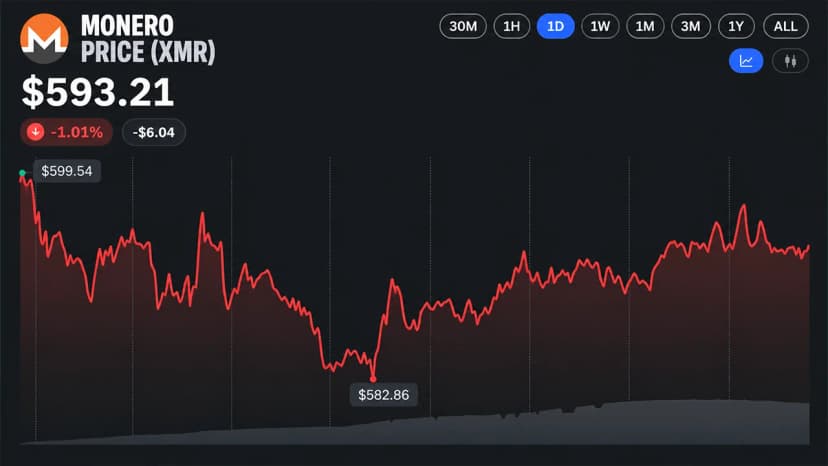
As of the latest data, Monero (XMR) is currently priced at 409,52 zł with a market capitalization of 7 554 310 633,07 zł. The 24-hour trading volume stands at 178 014 157,00 zł, The circulating supply of Monero is approximately 18446744.07370955. The cryptocurrency has seen a 1,16% increase in value over the past 24 hours.

Najlepsze pary dla Monero

AVAXAVAXXMRXMR
BTCBTCXMRXMR
BNBBNBXMRXMR
ADAADAXMRXMR
LINKLINKXMRXMR
DOGEDOGEXMRXMR
ETHETHXMRXMR
STETHSTETHXMRXMR
DOTDOTXMRXMR
SHIBSHIBXMRXMR
SOLSOLXMRXMR
XLMXLMXMRXMR

Obsługiwane giełdy

Binance logo
Binance
BTSE logo
BTSE
Kraken logo
Kraken
Azbit
BingX logo
BingX

Podobne monety do zakupu

Bitcoin logo
Bitcoin (BTC)
XRP logo
XRP (XRP)
Dogecoin logo
Dogecoin (DOGE)
FYDcoin logo
FYDcoin (FYD)
Stellar logo
Stellar (XLM)

Najświeższe stawki oprocentowania Monero (XMR)

Monero (XMR) Lending Rates

PlatformaMonetaStopa procentowa
KucoinMonero (XMR)Do 0,3% APY
Zobacz wszystkie 2 lending rates

Najlepsze ceny Monero (XMR)

PlatformaMonetaCena
BinanceMonero (XMR)118,7
BTSEMonero (XMR)559,9
AzbitMonero (XMR)568,18
BingXMonero (XMR)161,9
BitfinexMonero (XMR)565,32
BitmartMonero (XMR)566,97

1 — 6 / 27

Wyświetlanie od 1 do 6 z 27 wyników

PoprzedniNastępny

Najczęściej zadawane pytania dotyczące Monero (XMR)

What is Monero (XMR), and how does it differ from other cryptocurrencies?
Monero (XMR) is a privacy-focused cryptocurrency that aims to provide complete anonymity for its users. Unlike Bitcoin, which allows for transaction tracing, Monero employs advanced cryptographic techniques such as ring signatures and stealth addresses to obscure the sender, recipient, and transaction amounts. Launched on April 18, 2014, Monero is built on the RandomX hashing algorithm and features a block time of 2 minutes, ensuring rapid transaction processing while prioritizing user privacy.
How does Monero ensure the privacy and security of transactions?
Monero guarantees transaction privacy through several key features. It utilizes ring signatures to mix a user's transaction with others, making it difficult to identify the true sender. Stealth addresses generate one-time addresses for each transaction, concealing the recipient's identity. Additionally, the amount sent is obscured through Confidential Transactions, preventing anyone from viewing transaction values. Together, these technologies provide a robust layer of privacy and security, distinguishing Monero as a leader in anonymous cryptocurrency transactions.
What are the advantages of using Monero instead of Bitcoin?
Monero offers several advantages over Bitcoin, primarily in terms of privacy and anonymity. While Bitcoin transactions are traceable on a public ledger, Monero employs advanced cryptographic techniques such as ring signatures, stealth addresses, and confidential transactions to conceal the sender, recipient, and transaction amounts. Additionally, Monero's dynamic block size allows for greater scalability, accommodating varying transaction volumes without congestion, making it a more flexible option for users who prioritize privacy in their transactions.
How can users obtain Monero (XMR)?
Users can acquire Monero (XMR) through various methods, including purchasing it on cryptocurrency exchanges that list XMR, such as CoinEx, using fiat currency or other cryptocurrencies. Alternatively, users can mine Monero by participating in the network as miners, utilizing the RandomX algorithm, which favors CPU mining and promotes decentralization. Additionally, individuals can receive XMR through peer-to-peer transactions or by offering goods and services in exchange for Monero, taking advantage of its privacy features.
What is the significance of Monero's dynamic block size?
Monero's dynamic block size is a crucial feature that enhances the network's scalability and adaptability. Unlike cryptocurrencies with a fixed block size, Monero allows the block size to adjust according to transaction demand, enabling it to accommodate a higher volume of transactions during peak times without experiencing congestion. This flexibility helps maintain low transaction fees and quick confirmations, ensuring more efficient network performance. As a result, Monero can better serve its users while upholding its focus on privacy and security.